
Open 24 hours · on site within 2 hours2-hour response
Tarrytown Homes Hit by Wind or Water: Storm Damage Repair
Tarrytown has taken tornado winds, downpours of five inches or more and Hudson River flooding. Our crews travel from Harrison, about 15 road miles away, to dry out, clean up and rebuild after the storm.
Get a Free Estimate
Tell us what happened and we'll call you back. In a hurry? Call (718) 357-9191.
- Free estimates
- Open 24 hours
Tarrytown, NY
Who repairs storm damage to Tarrytown homes?
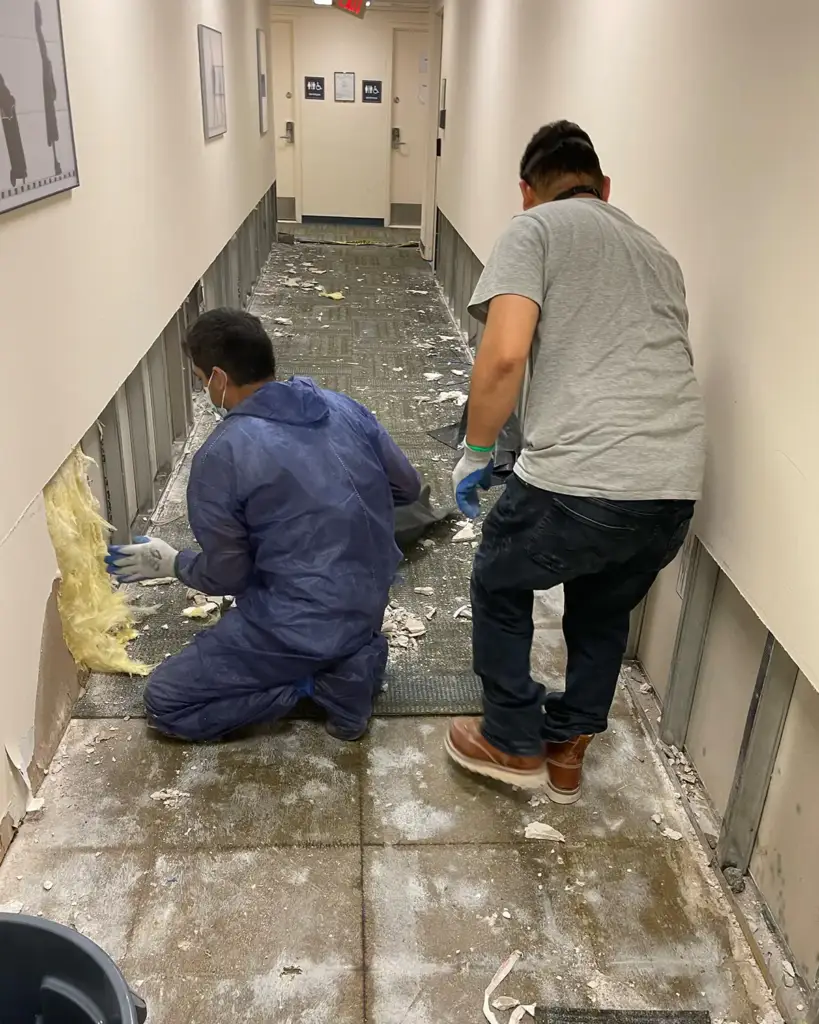
Strongwater Restoration takes on storm repairs in Tarrytown from its base at 111 Calvert Street in Harrison, roughly 15 road miles from Village Hall at One Depot Plaza. After wind, rain or river flooding, we dry the building, remove damaged materials and rebuild roofs, walls and interiors, near the station, downtown or up in Glenwolde Park.
About three in four Tarrytown homes, 76% of 5,653 units, predate 1980 according to the Census Bureau’s 2020-2024 survey, and the median build year is 1955. The village also holds two historic districts: North Grove Street, with mid-19th-century houses, and Glenwolde Park, whose Tudor Revival, Colonial Revival and Dutch Colonial homes went up in 1926. Repairs on houses that age may call for lead paint or asbestos work before rebuilding.
Housing: U.S. Census ACS 5-year estimates. Distance is approximate.
About Tarrytown
Which parts of Tarrytown face the most flood risk?
The low ground beside the Hudson. The county’s 2021 hazard plan says nearly 60 acres along the village’s northwest stretch of the river is prone to flooding, and the village’s comprehensive plan notes that FEMA maps put large portions of the station area inside the 100-year flood zone.
A gauge just south of the village recorded 6.97 inches during Ida in September 2021, 5.38 inches in the flash flooding of July 9-10, 2023, and 4.80 inches after the storms of July 21, 2026, according to National Weather Service storm totals. Route 9 at McKeel Avenue closed in May 2013 after flooding buckled the road, and Broadway between Prospect and Benedict Avenues flooded and closed in October 2017.
Wind has caused its own damage. On July 12, 2006, a tornado damaged roofs and siding on homes in the Tarrytown-Sleepy Hollow area before doing heavier structural damage in Pocantico Hills. The village’s section of the county hazard plan records that Tropical Storm Isaias cut power to about a quarter of the community in August 2020, with many trees down and roads closed, and that an April 2020 windstorm brought down trees and caused sewer backups.
The village climbs from the river. Lowlands west of the railroad hold parkland, marinas and commuter parking, while slopes and bluffs rise east of the tracks to a plateau along Broadway, Route 9. Only two crossings link the land west of the tracks to the rest of Tarrytown, and one, the 1930s H-Bridge over the Hudson Line, needs replacement. The Thruway and the approach to the Mario M. Cuomo Bridge cut across the village, and most addresses use ZIP 10591.
Permits & rebuilding
Does a Tarrytown storm repair need a building permit?
Almost certainly. Tarrytown’s Building Department says permits are required for almost all aspects of home construction, including roof and window replacement, siding changes, kitchen and bath renovations and finished basements, and it advises owners in doubt to assume one is needed. Electrical and plumbing permits are separate, and most exterior work also needs Architectural Review Board approval.
Getting a Tarrytown repair approved
- Apply online through the village’s SmartGov portal; the Tarrytown Building Department no longer accepts paper applications. Its office is at One Depot Plaza, 914-631-3668, open 8:30 a.m. to 3:00 p.m. on weekdays.
- Set aside a $100 application fee plus $20 for every $1,000 of renovation cost. Plumbing permits carry a $120 application fee plus inspection fees.
- Allow 10 to 15 business days for most permits, and know that legalizing work done without one costs double the permit fee.
- In a special flood hazard area, Village Code Chapter 169 requires a floodplain development permit from the Village Engineer, and repairs reaching 50% of market value fall under its substantial-damage rules.
- Look up the property’s flood map panel early. The village code cites FIRM panels 36119C0253F, 0254F and 0261F, effective September 28, 2007.
Services in Tarrytown
What storm and water services do we offer in Tarrytown?
Storm and flood restoration, water extraction and drying, sewage cleanup after a backup, mold remediation, fire and smoke work and full reconstruction. For the village’s apartment buildings we coordinate with property managers. We can also prepare repair estimates for a claim, though your insurer decides what is covered.
- Water Damage Restoration
- Fire Damage Restoration
- Smoke Damage Restoration
- Storm & Flood Damage Restoration
- Mold Remediation
- Sewage Cleanup
- Asbestos Abatement
- Lead Paint Removal
- Reconstruction After Damage
- Commercial Water Damage Restoration
- Commercial Fire Damage Restoration
- Restoration for Property Managers
- Estimating, Appraisal & Expert Witness
- Remodeling
FAQ
Tarrytown Questions
Who should Tarrytown owners call about a water main or service problem?
The village itself. Tarrytown’s Water Department, run by the DPW from One Division Street, operates its own system for about 12,000 people through roughly 2,300 connections, drawing mainly on New York City’s Catskill and Delaware aqueducts, with the Croton Aqueduct as an emergency source. The DPW handles sewers too. Once the line is shut off, call (718) 357-9191.
Is the area around Tarrytown station in a flood zone?
Large parts of it are. The village’s comprehensive plan says FEMA maps place large portions of the station area in the 100-year flood zone, with other recent development in the 500-year zone. Nearby, the Loh Park area was improved by 2019 to handle the 100-year storm, and eight Loh Park properties were interested in a FEMA map revision.
Do older Tarrytown houses complicate repairs?
Sometimes. About 29% of the village’s housing dates from 1939 or earlier, and both the North Grove Street and Glenwolde Park historic districts are in Tarrytown. Village Code Chapter 191 covers historic districts and landmarks, so allow time for reviews and expect original materials to be repaired with more care than a newer house would need.
How far is Tarrytown from your office?
Roughly 14.6 miles by road, or 10.6 miles in a straight line, separate 111 Calvert Street in Harrison from Village Hall at One Depot Plaza. Tarrytown is on the Hudson River side of Westchester, and we serve it along with the rest of the county.
Nearby
Which towns near Tarrytown do we also serve?
Tarrytown belongs to the Town of Greenburgh, on Westchester’s Hudson River side. From our Harrison office we also serve White Plains, Yonkers, Armonk and Scarsdale, the rest of the county, Greenwich and Stamford in Connecticut, and New York City. Each town below has its own page with local flood history and permit details.
Talk to Strongwater
Storm damage at a Tarrytown property?
Call (718) 357-9191. Our crews travel from Harrison, roughly 15 road miles from Village Hall.